Community Driven
TM
100% Decentralized
Community Driven
TM
100% Decentralized
Community Driven
TM
100% Decentralized
From Raw Logic to a Production-Ready Prediction dApp
PROBLEM
01
SHALLOW GROWTH INCENTIVES IN WEB3
Carrot was incubated within DXDAO to address a core Web3 problem: shallow marketing engagement. Instead of rewarding vanity metrics like likes or retweets, Carrot allowed projects to create prediction markets where community members stake capital on the outcome of real growth KPIs, such as whether a protocol would reach a target TVL within a set timeframe. If the goal was met, participants earned rewards. If not, the project got its budget back automatically through smart contract settlement.
The product existed entirely as a backend: smart contracts and manually executed scripts with no interface. Campaigns were created by developers through terminal commands. My task was to take this raw protocol logic and turn it into a product that non-technical users could operate independently.
MY ROLE
02
PRODUCT DESIGNER — CODE TO UI TRANSLATION
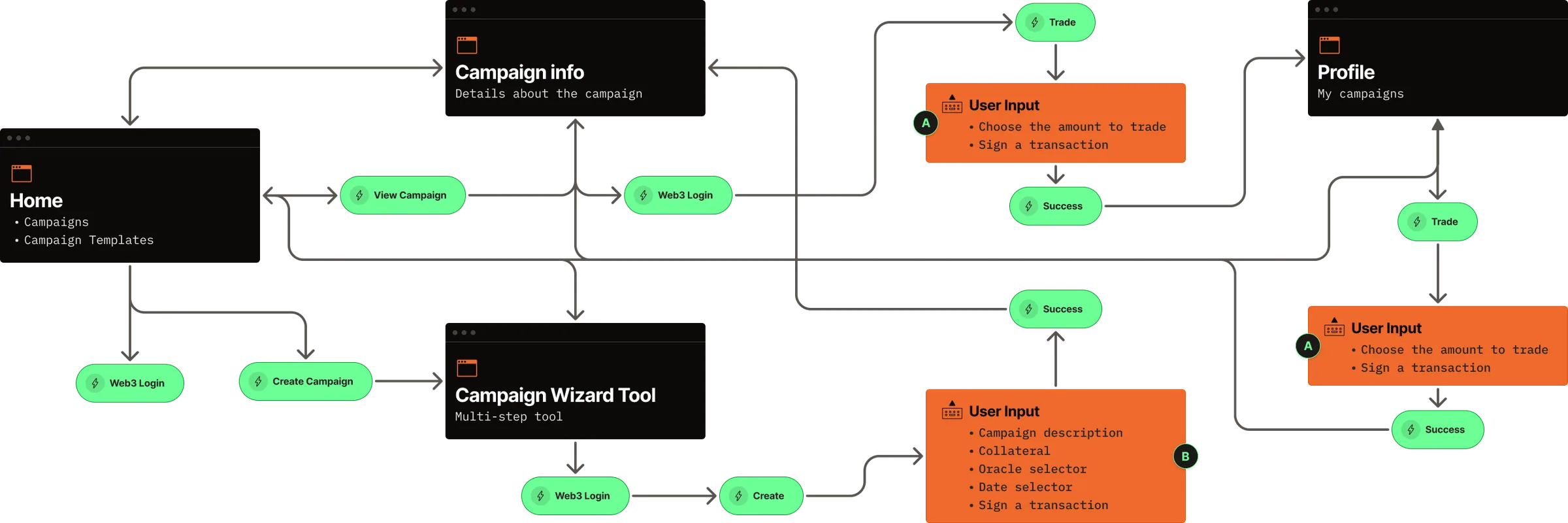
I acted as the bridge between engineers and end users, the sole designer on the project with full ownership across the dApp interface, campaign creation wizard, design system, documentation site, and marketing assets. An Art Director provided directional feedback throughout, but all design execution and decision-making was mine.Before my involvement, every campaign required direct developer intervention to create and manage. My role was to operationalize the protocol by mapping its logic, defining user flows, and translating manual workflows into a cohesive product experience built around close, ongoing collaboration with the engineering team.
video call discussion of creation logic
Design
PRODUCT
UX/UI
Brand
DESIGN
TOOLS
FIGMA
AFTER EFFECTS
Timeline
OCT 22 - APR 23
Team
DXDAO operated with structured community calls, transparent governance, and dedicated roles across product, marketing, and business development. I was recruited from 1Hive to join as the product designer responsible for Carrot, while also contributing across the broader DXDAO ecosystem: DAVI, a DAO governance and voting platform; Swapr (DEX) including a stats page redesign; as well as DAO presentations, hackathon event materials, and community marketing assets.
Over the course of the Carrot project I collaborated with:Art DirectorProject Lead / PMTech LeadSmart Contract Developers (multiple, across calls and GitHub)Frontend Developers (multiple, across calls and GitHub)Business Development ManagerMarketing ManagersCommunity Managers
RESEARCH
03
ORACLE MECHANICS AND THE TRUST BARRIER
Prediction markets in Web3 have a structural trust problem: campaign outcomes are determined by an external oracle, not the platform itself. For users staking real capital on a KPI outcome, this creates a fundamental question about whether the result will be verified correctly and what happens if it isn't.I researched how existing products handled this. Omen, Gnosis's prediction market, used Reality.eth as its verification layer, the same oracle system Carrot was built on. Studying how Omen exposed oracle status and settlement mechanics showed me where the trust gap lived: the resolution process was technically sound but almost entirely invisible to users.
To supplement this, I analyzed the developer-run test campaigns that existed before any interface was built. Watching how the protocol behaved through these campaigns made the settlement lifecycle concrete: what states a campaign moves through, where ambiguity appears, and what a user needs to see at each stage to feel confident their stake is safe.From this research I defined a dual-user model that became the foundation for all design decisions. Participants needed transparency: continuous visibility into oracle status, payout ratios, and settlement progress. Campaign creators needed reduced cognitive load, meaning a setup flow that mapped technical parameters to plain outcomes without requiring protocol knowledge.
The solution
04
A self-serve interface for a complex protocol
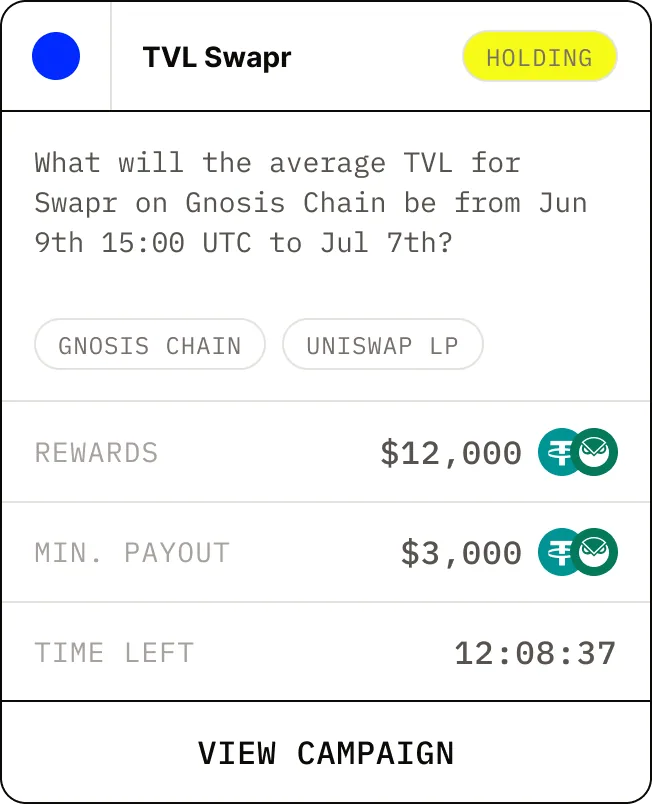
Reality.eth oracle → live campaign cardThe core trust problem in prediction markets is oracle visibility. Users staking capital on a KPI outcome need to know the verification process is happening and traceable. I mapped how Reality.eth settlement works at the contract level and translated each protocol state directly into the campaign card: active, pending verification, disputed, and settled. The card became a live data surface showing payout ratios, time remaining, and oracle status in real time, so participants never had to leave the interface to understand where their stake stood.
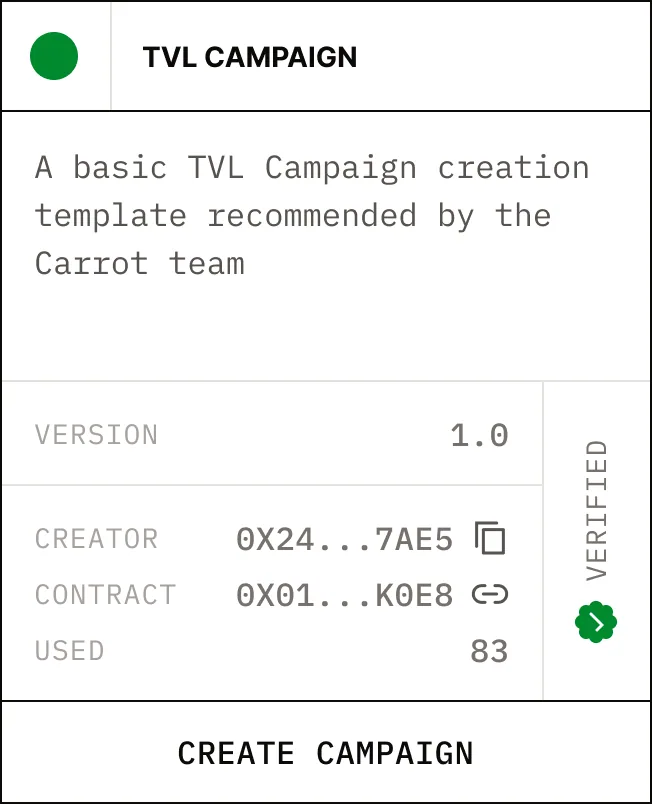
Campaign templateTo lower the barrier for campaign creators, I introduced pre-built campaign templates covering the most common growth KPI scenarios. Rather than starting from a blank configuration, creators could select a template, adjust the goal and reward parameters, and move to deployment in significantly fewer steps. Templates also reduced configuration errors by establishing sensible defaults for oracle settings and timeline structures that new creators would otherwise have to figure out manually.
Documentation
A technical documentation portal was designed as part of the same visual system as the dApp, covering protocol architecture, campaign mechanics, and oracle integration for both technical and non-technical audiences. This allowed Carrot to operate as a self-service product — partners could onboard, understand the protocol, and launch campaigns without developer support at any stage.
Design system and brand
Moodboard → brand comparison
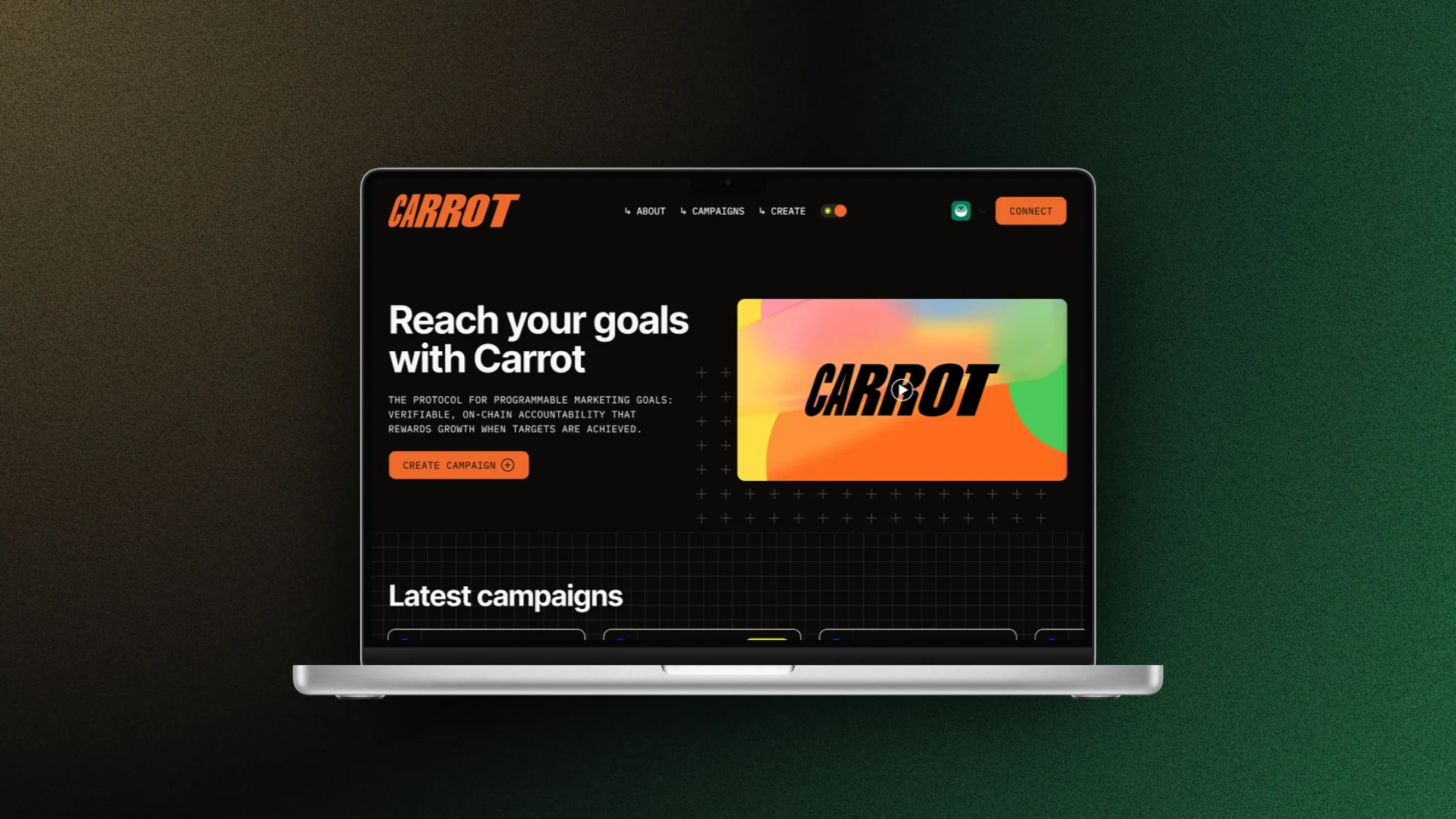
Before my involvement, Carrot had no interface, no visuals, and no design direction. Only smart contract logic and terminal-run scripts. I built the initial demo from scratch, giving the product its first visual footprint. Working with the Art Director from there, we defined a proper brand direction with a moodboard that set the tone and visual signals appropriate for a financial protocol built on verification and trust. The final identity moved away from the rough early demo toward something more precise and purposeful, with a restrained color system where accent was reserved strictly for state communication: risk, progress, and settlement status. From that foundation I took full ownership of the interface, translating the visual direction into a complete UI system covering every product surface.
Wizard flow video
The campaign creation flow was the primary friction point for non-technical users. The original process required 9 manual configuration steps exposing every protocol parameter at once: goal definition, reward structure, timeline, oracle settings, and settlement conditions with no guided logic. I redesigned this into a 5-step wizard that grouped related parameters, used smart defaults, and auto-generated the campaign name from the selected inputs. The video shows the full creation flow from blank state to deployment-ready campaign.

Demo vs final comparisonThe first version of the interface was built in days with no brief, a functional proof of concept to make the protocol tangible for the team. It worked, but it had no hierarchy, no visual language, and no system behind it. The final production design replaced every surface: a defined design system with component variants tied to campaign lifecycle states, a dark theme built for data density, and a consistent visual language across the dApp, documentation, and marketing. The comparison shows how far the product moved from that initial demo to a deployable, market-ready interface.

Together, the branding, interface evolution, and system foundation formed a coherent product language grounded in the protocol’s mechanics. This ensured the product could grow without fragmenting the experience or weakening user trust.

IMPACT
06
Carrot evolved from a developer-only tool into a production-ready product that attracted real partner activity. CoW Protocol and Swapr (DXDAO's native DEX), both ran test campaigns on the demo, validating the creation flow and campaign mechanics with actual usage before the full redesign shipped. Gnosis engaged at the exploratory level, evaluating Carrot as a potential growth mechanism for their ecosystem.The full redesign reached production-ready state before DXDAO was disbanded. The design system, creation wizard, documentation, and core interface were complete and ready for deployment.

Reflections
07
Carrot marked a turning point in how I approach design. I moved from designing individual screens to designing systems — where every interaction needed to align with how the protocol actually behaved on-chain. This made my decisions more deliberate and harder to separate from the product logic underneath them.
Working closely with engineers on a zero-to-one product showed me that strong design in complex systems comes from understanding the underlying mechanics first. Taking Carrot from raw contract logic to a cohesive, trustworthy interface confirmed that UX can be the difference between a protocol that exists and one that gets used.